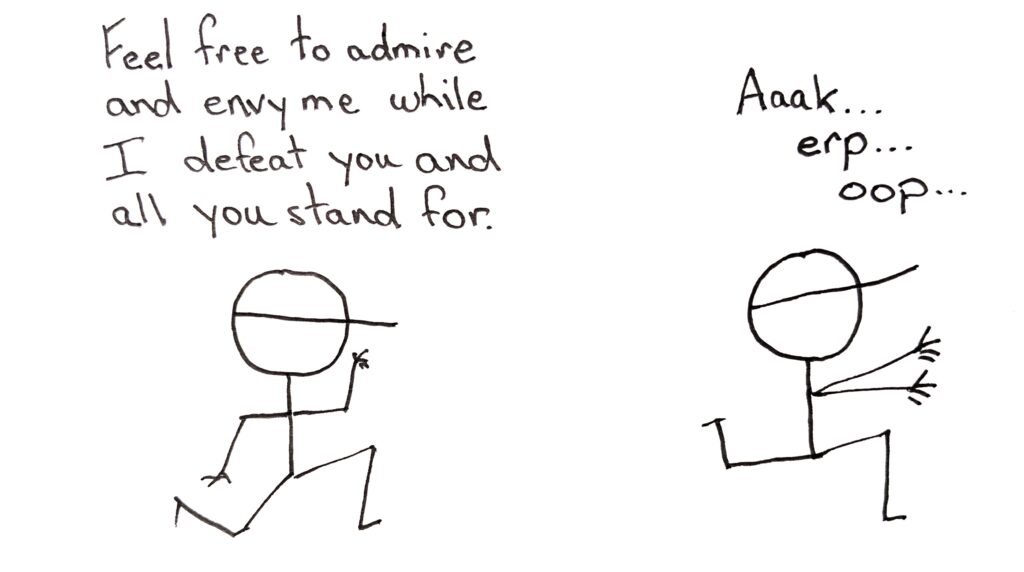
Too Good To Be True

If something, or someone, is too good to be true then …

You know.

Why then, are so many protagonists in best-selling novels so unbelievably good?

I have been writing a thriller, a broad sort of genre that means I am focussing a lot on a plot that is fast-paced. Characters are still important, though, especially as every thriller needs a good conflict or two and characters are our windows into all conflicts from geo-political bust-ups to a scrap between neighbours.

As I am supposed to read market-oriented thrillers because I am sort of trying to write one (it’s one of the rules you see all the time), I’ve spent some time grappling with a variety of protagonists with whom I am having some trouble.

Often, I am expected to care about a character who is presented as being rather impossibly … well, good. Rugged survivors, brooding yet humourous, tough but fair, patriotic (if they’re American but then they also have to have some kind of background in the military or love guns or both), dog loving, an imperfect parent (because that’s the only kind), insightful, thoughtful yet spontaneous, there they stand, signalling their virtue with every every line they utter, every observation they make.

Also, to my horror, authors use the word “savvy” to describe them.

Don’t get me started about that word.

Anyway, I must also point out that we are usually shown just a wee flaw that we don’t have to look too hard to see. They have a blemish or even two. Not arrogance, because arrogance does not seem to be a blemish, given its ubiquity in pop culture heroes.

My stomach is getting unsettled just thinking about them. And they crop up in the work of best-selling authors all the time. Actually, it’s probably one of the reasons the books sell so well.

What does that say about the writing problem, meaning the fact that it’s easy to write but hard to get someone to read what you’ve written?

Do my protagonists have to be so dang-nabbed good that I hate them and myself for writing them?

Self-loathing is not why we get into this game, at least not most of us. But the sort of self-loathing that sells has to be on the page, not simply a result of having written. What good is cringing dark hatred of oneself if it doesn’t bring in a royalty cheque?

I know I am being unfair. There are lots of loathsome anti-heroes, quirky unreliable narrators and fundamentally, fatally flawed protagonists out there. I am just not sure how they ever got published.

How about a protagonist who is mostly sympathetic but makes big mistakes and is conflicted all the time about hard choices? Someone who dwells in the space between the rock and the hard place and makes character-based mistakes in judgment is surely more interesting than someone who simply confidently faces problems in succession and makes the best decisions based on the information they have while punching, escaping, or otherwise outsmarting bad guys.

Naah.

Give ‘em what they want.

Troy Storm, veteran of a forgotten foreign war, PTSD survivor, runs a non-profit dog-rescue, step father to an adored eight-year-old girl whom he teaches to shoot a pistol (only in self-defence of course), partner of a savvy no-nonsense kindergarden teacher who kick-boxes to raise money for orphans in El Salvador, moonlights as personal security to visiting foreign dignitaries … .

From there it writes itself when you factor in a really bad guy.

See Bad to the Bone.

Done.
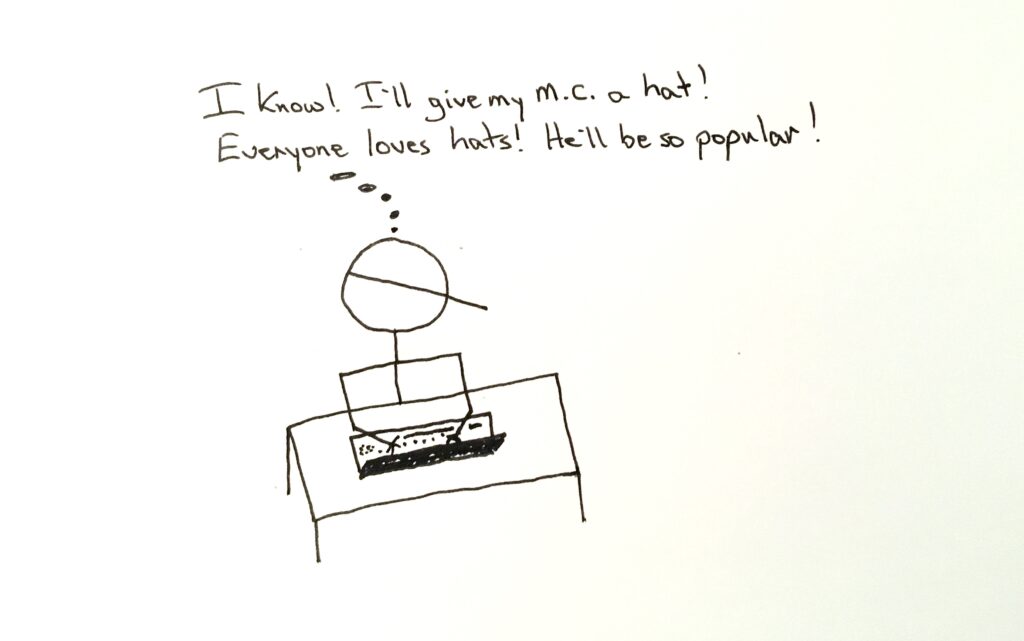
Big Mistake

I made a mistake yesterday. I watched a movie from about twenty-five years ago. It was called A Perfect Murder, and what became clear as I watched was that nothing was in any way perfect about this film. Including the murders. And attempted murders.

Besides the plot holes and the poor direction (where’s the suspense?) the characters were what really got my attention. 

There kind of weren’t … any. 

Please bear with me as I rant.

The protagonist, played by Gwyneth Paltrow, is supposedly in some progressive United Nations job (she mentions the word refugees as a way of signaling her deep commitment to humanity) dressed in a fur coat and five-hundred-dollar shoes, a job which seems to allow her extended lunches a couple of times a week so that she can go off to have nooners with her arty boyfriend is his ridiculously huge studio.

What becomes evident is that, far from being likable, hateable, relatable in any way, she has no character at all. Beyond her ability to part her lips just so when she is trying to appear frightened, surprised, perplexed, sympathetic, aroused, or whatever, a store mannequin could fill in. Now, it would have to be from a posh, exclusive store, because our protagonist is just about as white, as privileged, and as rich as a person can be.

Her husband is the malevolent Michael Douglas, who also has little or nothing that might be counted as character except that he’s … malevolent. He looks good in layers of expensive clothes, and likes to comb his hair back, and if that’s not a clue to deep-seated complex and fascinating personality pathologies, I don’t know what is.

Anyway, he plots to kill Gwyneth using her boyfriend as the blunt instrument. Having found out about the artist’s shady criminal past and about the quality lunches available in Manhattan to UNO personnel, he threatens and bribes the boyfriend to turn on Gwyneth so that hubby can inherit her birthright, a fortune of about a hundred million.

The boyfriend, Viggo Mortenson, threatens to have character when we find out that he learned to paint in prison (is that even a thing?) and he likes to hook up with rich women and walk away with more than their deep appreciation. Later on, when he thinks poor Gwyneth is dead (having hired his inept buddy from prison art school to do the deed for him) he seems distraught. Later, finding out she’s alive and kicking, he seems happy as a clam to leave town for good without her. So, his character is … whatever?

Movies don’t have lots of time for character development, but we should like somebody shouldn’t we? Why cheer for the heroine who is simply exceedingly privileged? 

Should we like her just because her husband’s a bonafide member of the Capitalist-Killer fraternity? 

Because she has bad taste in lunchtime wrestling partners? 

The film shows us nothing else about her but for the fact that she speaks a little Arabic, which is supposed to be some other signal of her all-around terrificness.

A police detective, played by David Suchet, shows up and we are briefly hopeful that an actual character has arrived, as his face demonstrates more complex elements in the first ten seconds on-screen than anyone else does in two hours. But his part is tiny and completely without effect on the plot. A waste.

Who cares, though? It’s a lousy twenty-five-year-old film. Why did this bother me?

What must have been happening was that the director and writer were thinking that just drawing an outline of a rich attractive woman with a New York job would get an audience to like her and cheer for her. And that’s the problem. Assuming an audience’s good will. Big mistake.

Assuming a reader’s, or an audience’s good will or support for a character has to be fatal. We have to have a reason to care. If your protagonist is going to save the universe, we better care about them over and above the saving part. 

We are readers. 

We’re safe at home. 

We don’t need to be saved. What we need is to read about or watch someone interesting. And that is one of the biggest challenges of writing fiction – we have to make readers care without falling into trope or cliché. 

The finest prose imaginable will not make me want to read about someone I don’t care about. It would be a terrible mistake to assume any reader of my work would be different. 

People don’t want to read simply because I want to write.

Damn!

So much work.