There are loads of adverb haters, people who say they would like to exterminate them.
I agree only to the point that you often don’t need them if the rest of the page is okay.
Take, for instance, this:
“Clearly,” Beau said, “this is a really bad sentence.”
Clearly and really add nothing to the meaning. I have gone through my own works in progress and searched for these words. Out of every twenty I find, there may be a reason to keep one. Maybe. Very is the same and more so. Unnecessary.
Then there are the speech tag haters. They are mostly but not always right. Consider the speech tag for Beau. We probably know Beau’s talking, or that it’s his turn to talk. Or that he’s the one who’s likely to say something like this. He’s a bit of a pill that way.
I found some short stories by Agatha Christie that I don’t remember having read and saw that she seldom used speech tags. When Poirot is speaking, everyone knows he’s speaking.
However, one genteel murder suspect in an English country home must at times be discriminated from another. Best done with a descriptive phrase.
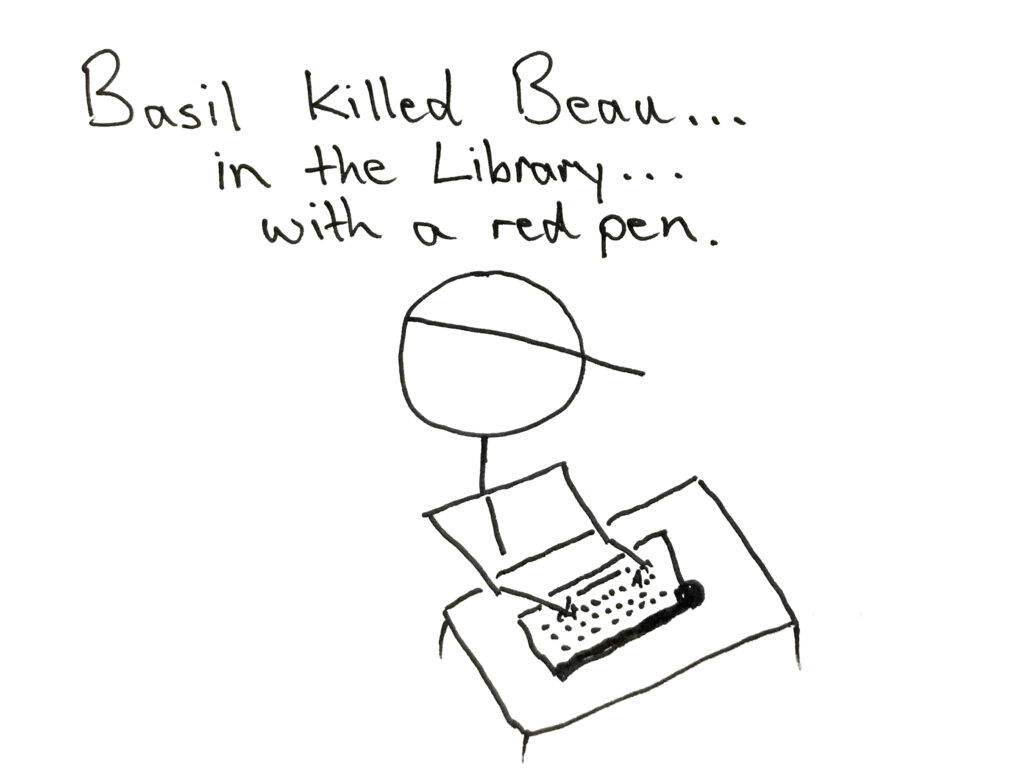
“We were playing tennis all afternoon,” said Basil.
Basil struck a match. “We were playing tennis all afternoon.”
The second is much more fun, as long as there is not so great a hurry to get on with the interrogation that you can’t add a couple of words.
So, we don’t need the adverbs or the speech tag.
We are left with, “This is a bad sentence.”
Why use the pronoun?
“Bad sentence.”
Isn’t that enough? If we know what’s going on and someone’s assessing the quality of a sentence, I mean.
And maybe it’s better if we just say, “Sucks.” or “Shite.”
Now, a novel is not film noir and we can’t ask every character to be so fascinatingly non-verbal that we can reduce the dialogue to a bunch of monosyllables and grunts but if you are prone to over-writing, as I am, the idea of pairing it down as far as possible during editing is vital.
Really vital.
Really, very vital.